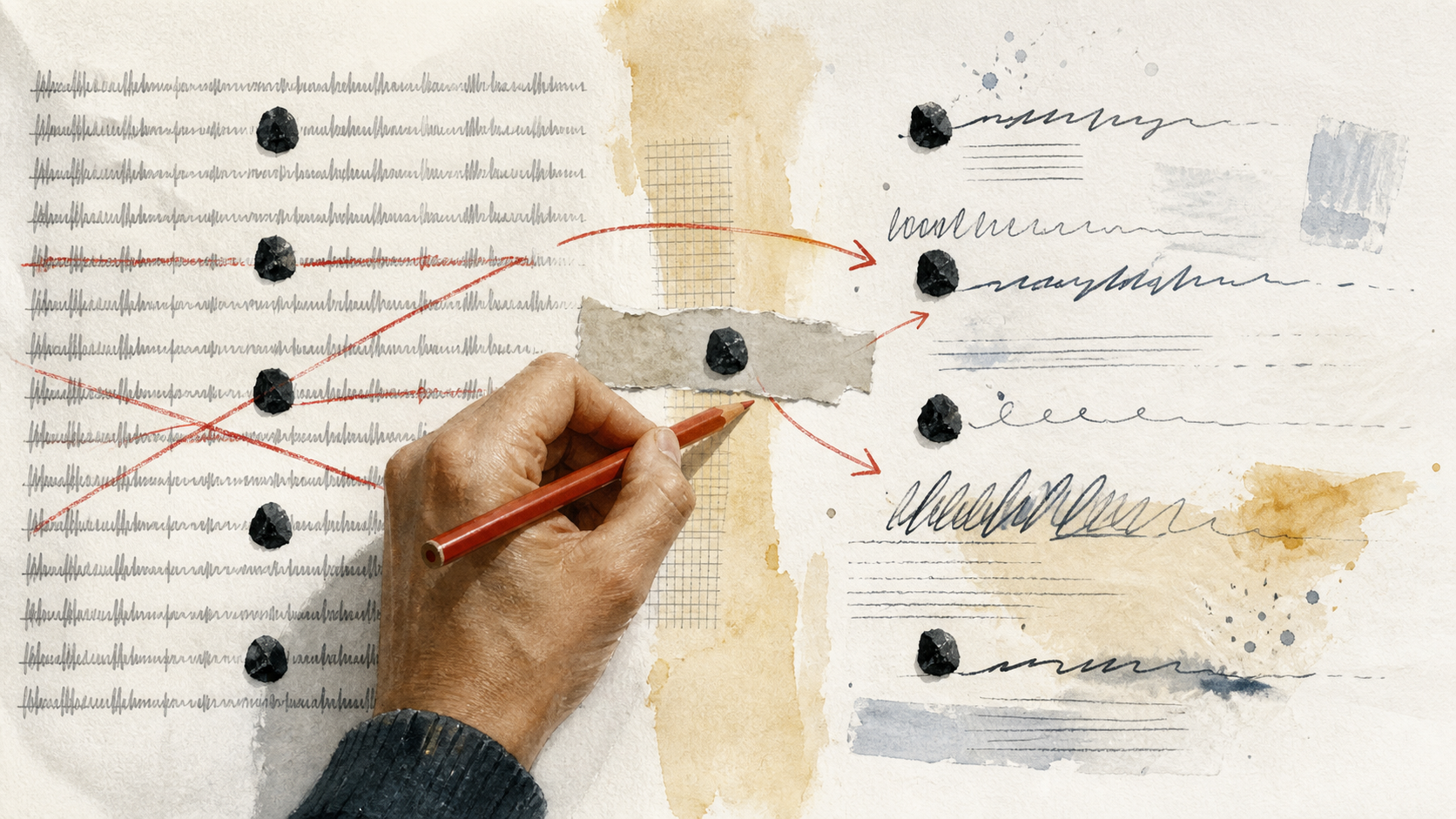
Humanizing AI writing without making it worse
Most AI writing does not fail because it is written by AI. It fails because nobody edits it after the model is done.
That distinction matters. Google does not say "AI content is bad." Its public guidance is closer to this: useful content made with AI can be fine, but pages made mainly to manipulate search rankings are spam. So the real question is not "How do I hide AI?" It is "How do I turn a draft into something a person would actually want to read?"
The open-source Humanizer project by blader is interesting because it treats the problem as editing, not magic. It uses patterns from Wikipedia's "Signs of AI writing" page, then checks whether the rewrite kept the original claims intact. That is the part worth stealing for your own workflow.
What AI writing usually gets wrong
AI drafts tend to sound smooth before they are useful. They round off the edges. They use the same confident rhythm for a product update, a personal story, a technical fix, and a legal disclaimer. The result is readable at first glance and forgettable by the second paragraph.
The common tells are not mysterious:
- inflated claims
- vague sources
- repeated sentence shapes
- stock phrases like "it is important to note"
- forced groups of three
- generic endings
- too much polish around too little evidence
Wikipedia's AI cleanup editors built a long list of these patterns because they kept seeing the same problems in submitted articles. Some were only style issues. Others were more serious: fake citations, claims that did not match sources, and text that sounded authoritative while saying very little.
That is the real risk. Not the em dash. Not the word "moreover." The risk is a page that sounds finished before the facts have been checked.
Do not start with an AI detector
AI detectors are a weak place to begin. They can be useful as a rough signal, but they are not proof. Research and classroom experience keep showing the same problem: detectors can miss AI text, and they can flag human writing. That makes them risky as the final judge of whether writing is trustworthy.
A better test is simpler:
Can a reader tell who this is for?
Can they see what changed, what to do next, or what tradeoff matters?
Are the numbers, dates, names, commands, prices, and links real?
If the answer is no, the text is not ready. It does not matter whether a detector gives it a green score.
The useful part of Humanizer
Humanizer is an agent skill, but the useful idea is bigger than the tool. It does three things well:
First, it separates style from facts. A rewrite is allowed to change the rhythm, but not the claims.
Second, it checks for known AI patterns. That keeps the editor from only fixing the obvious first paragraph.
Third, it keeps technical and reference writing plain. Not every sentence needs personality. A setup guide should be clear before it is charming.
That is a good default for AI-assisted writing in general. The goal is not to make text "undetectable." The goal is to remove the parts that make readers feel like nobody looked at the draft.
A practical editing workflow
Here is the workflow I would use before publishing an AI-assisted article.
1. Lock the facts first
Before rewriting anything, list the claims that must survive:
- product names
- model names
- dates
- prices
- API paths
- limits
- examples
- source links
If a fact is missing, do not invent it during the rewrite. Add a note, find the source, or remove the claim.
2. Replace vague authority with real evidence
Bad AI draft:
Experts say AI humanization is becoming essential for modern content teams.
Better:
Google's Search guidance says AI-assisted content can be acceptable when it is useful and people-first, but scaled content made mainly to manipulate rankings can violate spam policies.
The second version is less dramatic. It is also more useful.
3. Remove the fake drama
AI drafts love sentences that sound like a documentary trailer:
This marks a pivotal moment in the evolution of digital writing.
Most of the time, the honest version is shorter:
This gives writers a checklist for editing AI drafts.
If the dramatic version does not add information, cut it.
4. Break the model's rhythm
AI often writes in evenly weighted paragraphs. Each sentence has the same confidence. Each section ends with the same tiny conclusion.
Human writing has more shape. Sometimes a point needs one sentence. Sometimes it needs a concrete example. Sometimes the best paragraph is blunt:
The citation was fake.
Use sentence length to match the meaning, not to make the page look balanced.
5. Keep useful imperfection
Do not sand everything flat. If the article is about a bug, say what was confusing. If a tool has a sharp edge, name it. If the setup took trial and error, include the part that would save the reader ten minutes.
That kind of detail is hard to fake and easy to appreciate.
Before and after
Here is a small example.
Before:
AI writing tools are transforming the content landscape by empowering creators to produce high-quality content at scale. However, ensuring authenticity and maintaining a human touch remains a crucial challenge for brands and individuals alike.
After:
AI can get a draft on the page quickly. The problem is that the draft often sounds finished before it has earned the confidence. Good editing fixes that by checking the facts, cutting vague claims, and adding the details a reader came for.
The second version is not trying so hard to impress you. It says what changed and what to do about it.
What this means for SEO
If you are publishing AI-assisted content for search, the safest habit is to make each page useful enough that it could stand without the AI angle.
That means:
- answer a real question
- show examples
- cite primary sources where possible
- avoid mass-producing thin pages
- update pages when facts change
- remove filler before publishing
For ISH, that is the standard I want for the blog: practical AI writing, model updates, setup guides, debugging notes, and honest comparisons. Not a hundred pages saying the same thing with different headings.
A short checklist
Before you publish an AI-assisted post, ask:
- Did I verify the factual claims?
- Did I remove claims that only sound impressive?
- Did I replace vague sources with links?
- Did I add examples from actual use?
- Did I cut the generic intro and ending?
- Would this help someone even if they skipped the brand name?
If yes, the page is probably in decent shape.
If no, do not "humanize" it yet. Fix the substance first.
Sources
- Humanizer by blader: https://github.com/blader/humanizer
- Wikipedia: Signs of AI writing: https://en.wikipedia.org/wiki/Wikipedia:Signs_of_AI_writing
- WikiProject AI Cleanup: https://en.wikipedia.org/wiki/Wikipedia:WikiProject_AI_Cleanup
- Google Search guidance about AI-generated content: https://developers.google.com/search/blog/2023/02/google-search-and-ai-content
- Google guidance on generative AI content: https://developers.google.com/search/docs/fundamentals/using-gen-ai-content